Blog Posts
What Is Pilates? A Beginner's Guide to Starting | ALIINE

Most of fitness culture runs on high-impact exertion and pushing yourself to exhaustion. Pilates doesn't. It's built on precision, structural control, and a level of physical awareness that most workouts never ask of you. Joseph Pilates developed the system in the early twentieth century under the name "Contrology", originally to rehabilitate injured athletes, correct postural alignment, and restore natural movement patterns from the inside out.
If you're new to it, walking into a studio or stepping onto a reformer for the first time can feel intriguing and a little intimidating, both at once. That's partly because so many people misunderstand what Pilates actually is. It isn't just a sequence of core exercises or a set of passive stretches. It's an integrative discipline that brings breath, precise muscle recruitment, and joint articulation together to re-educate how your body supports itself.
Whether you're trying to ease the chronic tension that comes from a desk job, build real core stability, or complement more advanced bio-optimisation therapy, understanding what Pilates is at a foundational level is the first real step toward better movement quality.
What Is Pilates? Core Science and Principles
From the biological perspective, Pilates is a mind-body conditioning system focused on the deep structural muscles responsible for postural stability, spinal alignment, and balanced joint movement. Where most workouts train the muscles you can see, Pilates conditions the entire kinetic chain, both visible and invisible.
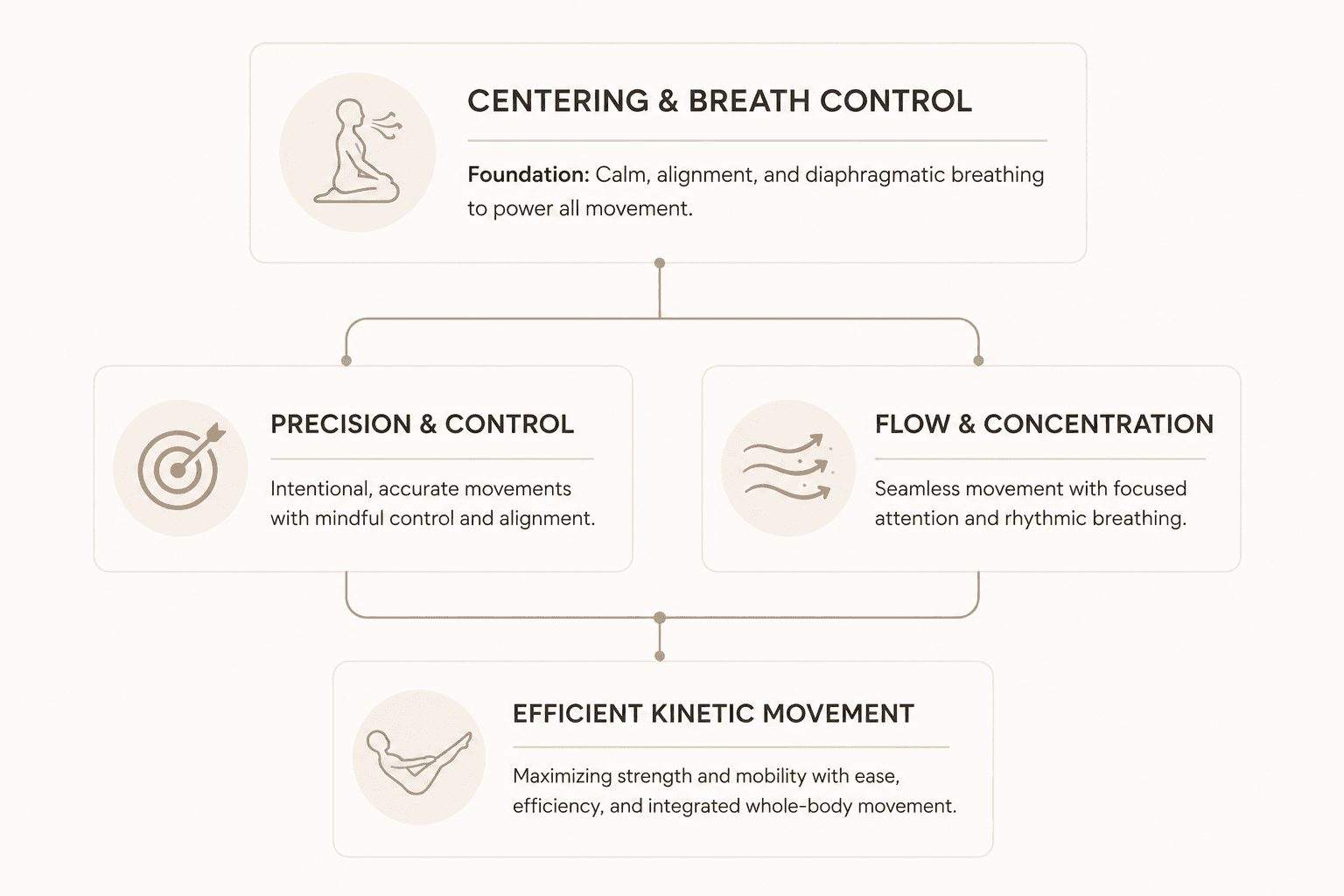
Every classical and contemporary Pilates exercise runs on six core principles:
Centring: every movement starts from the body's physical centre, often called the powerhouse: the transverse abdominis, pelvic floor, multifidus, and diaphragm.
Control: exercises are executed through deliberate, conscious muscle engagement, not momentum or gravity doing the work for you.
Precision: exact body placement, joint angles, and subtle alignment cues matter because they determine which muscles actually fire.
Breath: lateral thoracic breathing expands the ribcage, oxygenates tissue, and helps regulate nervous system stress as you move.
Flow: movement phases connect smoothly into each other, building continuous, graceful motion instead of jarring the joints.
Concentration: full mental focus stays on the specific mechanics being performed, session after session.
If you've been wondering what Pilates means in practice rather than in theory, this is really it: a system where the mental focus and the physical mechanics are inseparable. You can't do it on autopilot.
Mat vs. Reformer: Understanding the Primary Formats
New to the practice? You'll typically run into two foundational formats: Mat Pilates and Apparatus-Based (Reformer) Pilates.
Mat Pilates uses your own body weight against gravity as the primary source of resistance.
Exercises happen on a specialised, cushioned mat. You engage your deep core muscles to stabilise the spine while moving your limbs through controlled patterns.
Mat work builds an excellent foundation for body awareness, breath coordination, and core engagement, with no external mechanical support involved.
Best suited for: Building a solid foundational understanding of movement control, practising at home, and developing body-weight resistance ability.
This is probably what comes to mind when people ask what a Pilates workout actually looks like in a studio: a sliding carriage, adjustable springs, pulleys, and straps.
The spring mechanism provides variable resistance, which can either assist a beginner through a challenging range of motion or add dynamic resistance to build deeper muscle density.
The Reformer gives your nervous system direct feedback, making it much easier to catch subtle postural shifts or muscle imbalances between your left and right sides.
Best suited for: Targeted joint articulation, eccentric muscle strengthening, active rehabilitation support, and progressive strength development.
The Primary Benefits for Beginners
Once you build a consistent Pilates practice, the shifts tend to cascade across your entire physical structure and how you move day to day:
Targeted core stability: strengthens the deep internal muscle wall, building internal support that protects the lumbar spine from everyday strain.
Postural realignment: counteracts forward head posture, rounded shoulders, and tight hip flexors caused by prolonged sitting.
Joint lubrication: encourages smooth, multi-directional joint movement that promotes fluid exchange and reduces joint friction.
Stress reduction: Rhythmic, breath-focused movement activates the parasympathetic nervous system, lowering cortisol and relaxing tight muscles.
Feature | Mat Pilates | Reformer Pilates |
Primary Resistance | Body weight against gravity | Calibrated spring tension and pulleys |
Feedback Mechanism | Internal body awareness | External mechanical feedback from the sliding carriage |
Setup & Accessibility | Highly accessible; requires only a mat | Requires specialised studio equipment and clinical guidance |
Target Application | Fundamental core control and mat work | Targeted joint articulation and variable muscle loading |
Beginner Checklist: How to Start Your Practice Correctly
A few foundational guidelines to get the most out of your first few sessions:
✔ Prioritise form over amplitude: Small, precise movements with proper alignment beat pushing into a deep range with poor posture every time.
✔ Master the lateral breath: Practice expanding your ribcage sideways and backward on the inhale, keeping your abdominal wall engaged as you exhale.
✔ Listen to your body's baseline: Pilates should create deep muscle engagement, not sharp joint pain. Say something to your instructor if a movement feels unsafe.
✔ Maintain consistency: Aim for two to three sessions a week; that's roughly what your nervous system needs to build new motor patterns and lock in structural adaptations.
The ALIINE Approach: Movement and Longevity Integration
At ALIINE, we don't treat Pilates as an isolated workout. It's an active pillar within a complete health and longevity framework.
Our beginner protocols as part of Aliine Pilates combine movement with tailored reformer and mat work. We evaluate your posture, spinal mobility, and physical baseline first, and from there our team aligns your Pilates practice with advanced recovery and bio-optimisation technology, EMS activation, infrared vacuum, and cellular recovery in the ReVitale Chamber.
This integrative approach helps you build a strong, mobile, well-aligned physical foundation, one that actually supports an active lifestyle for years, not just a few months.
Frequently Asked Questions
How often should a beginner do Pilates?
Beginners should aim for 2 to 3 sessions per week. This frequency gives your nervous system and muscle tissue enough time to adapt to new movement patterns while allowing adequate rest for tissue recovery.
How long should a beginner do Pilates for?
A typical beginner session lasts 45 to 60 minutes. If you are starting on your own or rebuilding baseline strength, shorter 20 to 30-minute targeted sessions are also effective for establishing core control.
Can I learn Pilates by myself?
You can learn basic mat exercises through guided online programs, but working with a qualified instructor initially is recommended. Personal guidance ensures correct alignment and proper breath integration and reduces the risk of joint strain.
How do I start Pilates for beginners?
Start by attending an introductory mat or reformer class with a certified instructor. Focus on mastering foundational principles like lateral breathing, neutral spine alignment, and deep abdominal activation before trying advanced movements.
Is Pilates harder than yoga?
Neither is inherently harder; they present different challenges. Pilates requires continuous, dynamic muscle engagement and precise movement control, whereas yoga often demands static balance, flexibility, and sustained pose holds.