
Blog Posts
10 Benefits of Pilates for Strength, Flexibility & Mobility | ALIINE
Physical longevity isn't just about building visible muscle or forcing your joints through a deep passive stretch. It takes functional movement quality, real joint articulation, structural resilience, and a nervous system that knows how to regulate itself. Modern life has a way of working against all of that (long hours sitting, repetitive strain from the same few movements, and chronic stress), and the result is stiff joints, uneven posture, and a fatigue that never quite lifts.
Most conventional fitness protocols isolate one muscle group at a time, usually in a single plane of movement. Pilates doesn't work that way. It's a complete movement practice, built to recondition the body from the inside out through controlled breath, precise muscle recruitment, and dynamic resistance that restores how the body is actually meant to move.
Whichever benefits of Pilates you're chasing, whether you're pairing it with advanced bio-optimisation technology or using it as your primary movement discipline, the payoff shows up systemically and in how your body performs day to day.
Defining the Core Metrics: Strength, Flexibility, and Mobility
Before diving into what are the benefits of Pilates specifically, it's worth untangling three terms people tend to lump together:
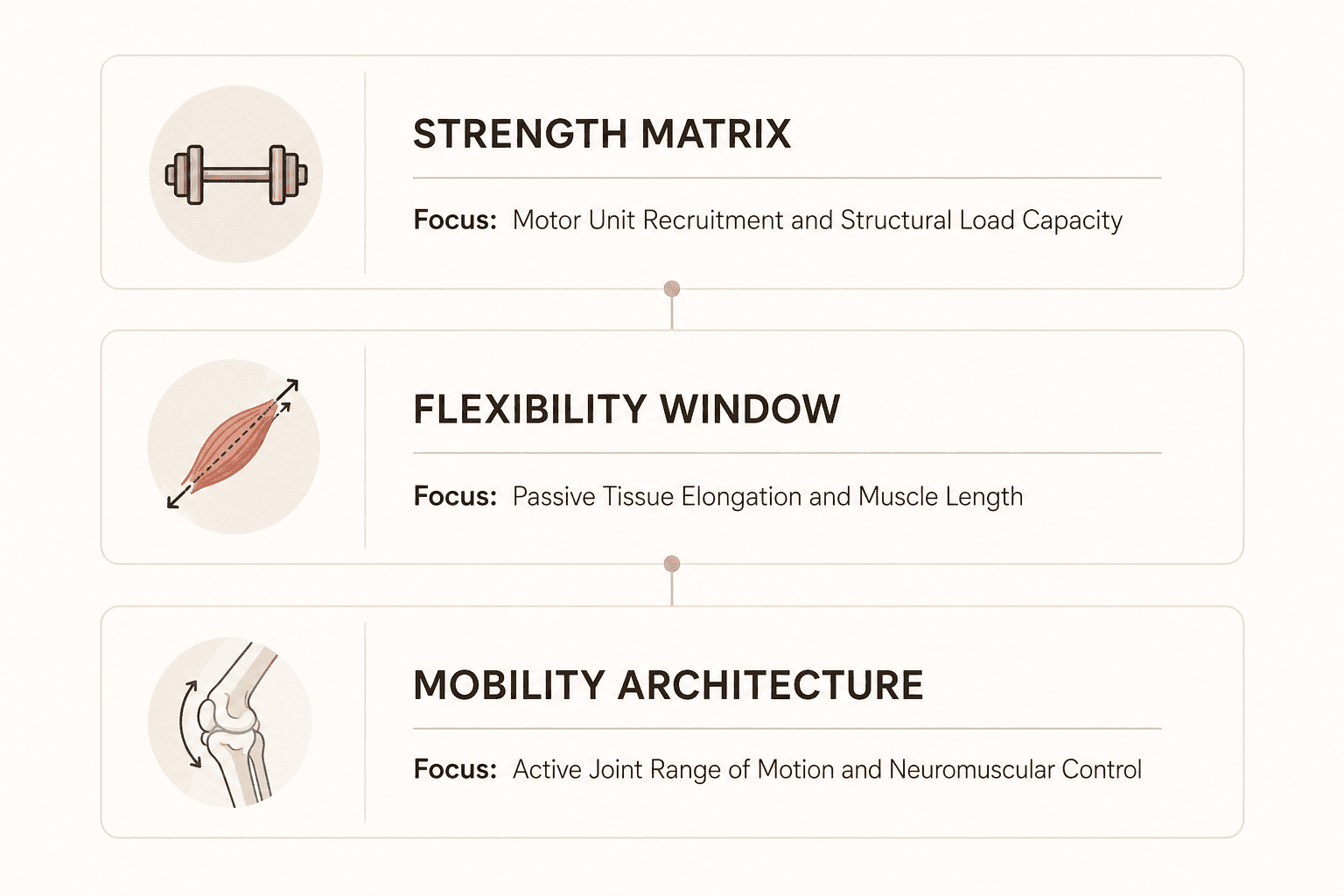
Functional strength is your neuromuscular system's ability to generate force across multi-joint movement patterns while keeping the structure stable.
Flexibility is simply the passive length capacity of muscle and connective fascia, i.e., how far a joint can lengthen.
Active mobility is the usable, controlled range of motion at a joint, which depends on a balance of flexibility, active strength, and nervous system regulation working together.
Pilates sits right at the intersection of all three, which is really what makes it different: your joints move freely, but under active neuromuscular control the whole time.
The 10 Structural Benefits of Pilates
Deep Core Reconditioning and Local Stability
Traditional ab exercises mostly recruit superficial muscles, like the rectus abdominis you can see. Pilates goes deeper, systematically activating the transverse abdominis, internal obliques, pelvic floor, and multifidus. That builds a natural internal support system around the lumbar spine, protecting your lower back from shearing forces during everyday movement and athletic performance alike.
Restored Spine Articulation and Disc Hydration
Your spine was built to move segmentally through flexion, extension, lateral bending, and rotation. Sit still long enough, though, and entire regions start moving as one rigid block instead. Pilates trains segment-by-segment spinal movement, which encourages microcirculation and fluid transfer into the intervertebral discs, in turn improving spinal health and mobility over time.
Balanced Agonist and Antagonist Muscle Balance
Repetitive movement and poor posture tend to create uneven muscle tone, which pulls joints out of alignment and creates friction and early wear. Pilates emphasises balanced kinetic movement so both sides of the body and opposing muscle groups engage equally. That correction reduces stress on the hips, knees, and shoulders over the long run.
Dynamic Eccentric Muscle Strength
Concentric strength happens when a muscle shortens under load; eccentric strength happens as it lengthens under tension. The spring resistance in Pilates (on reformers, towers, and chairs) creates a constant eccentric load, which builds long, dense muscle fibre, increases how much force your body can absorb, and reduces tendon strain during explosive or load-bearing movement.
Increased Active Joint Range of Motion
Passive stretching lengthens muscle tissue, but it doesn't necessarily teach your brain how to control that new range, which can actually leave a joint more vulnerable to strain, not less. Pilates uses active stretching instead, requiring the surrounding muscles to generate stability at the outer edge of a joint's movement. That's what turns passive flexibility into safe, usable mobility across the hips, shoulders, and thoracic spine.
Enhanced Proprioception and Neuromuscular Control
Proprioception is your nervous system's internal map of where your body sits spatially. Pilates sharpens the sensory pathways between peripheral nerve receptors and the brain by demanding deliberate speed, constant alignment checks, and precise positioning, which shows up as better balance, coordination, and general physical agility in daily life.
Improved Postural Alignment and Structural Symmetry
Screens have trained most of us into forward head posture, rounded shoulders, and an anterior pelvic tilt without anyone noticing it happen. Pilates counters that directly, strengthening the deep upper-back extensors, stabilising the shoulder girdle, and restoring a neutral pelvis. Over time it re-educates your baseline posture entirely, so you stand taller with less effort and less strain.
Optimised Breathing Mechanics and Nervous System Balance
Diaphragmatic breathing runs through every single Pilates movement. Coordinating breath with lateral thoracic expansion improves respiratory volume and oxygenation, and the deliberate, rhythm-guided pattern of it helps down-regulate the sympathetic nervous system, shifting the body toward parasympathetic recovery, which lowers cortisol and eases muscle tension system-wide.
Reduced Joint Impact and Injury Prevention
High-impact training puts real stress on articular cartilage and connective tissue, especially if you're recovering from a joint strain or managing inflammation. Pilates gives you a low-impact, high-intensity alternative; it loads the muscles hard without subjecting the joints to harsh impact. That's a big part of why it works so well for long-term athletic longevity and active rehab.
Synergistic Integration with Technology-Led Modalities
Pilates pairs naturally with advanced bio-optimisation technology. Combined with EMS (electrical muscle stimulation), infrared circulation protocols, or cold-based recovery, it bridges the gap between passive cellular recovery and active, conscious movement, which is where a lot of the Pilates exercise benefits and Pilates workout benefits compound rather than just add up.
Comparing Movement Approaches: Pilates vs. Traditional Training
Feature | Traditional Weight Training | Conventional Passive Stretching | Pilates Practice |
Primary Structural Focus | Concentric force and muscle mass | Passive muscle lengthening | Active mobility, core stability, and control |
Joint Interaction | High compression under external load | Minimal active joint stabilisation | Dynamic articulation with low joint impact |
Nervous System Impact | High sympathetic drive | Mild parasympathetic relaxation | Balanced neuromuscular focus and breath control |
Movement Planes | Frequently linear (sagittal) | Static single-plane angles | Multi-directional, multi-plane movement integration |
The clinical benefits of Pilates specifically come through in that last row and column; it's the multi-plane, breath-integrated approach that neither weight training nor static stretching really replicates on its own.
Integrating Pilates Across Different Life Phases
The adaptability of spring resistance and mat work means Pilates protocols can flex to meet very different physiological needs:
Athletic performance and longevity: Dynamic eccentric strength, rotatory power, and rapid muscular deceleration to guard against soft-tissue strain.
Postural re-education for desk-bound professionals: Thoracic spine extension, hip flexor lengthening, and shoulder blade stabilisation to offset prolonged sitting.
Active longevity and joint health: Joint lubrication, balance, pelvic floor stability, and bone density support through low-impact resistance.
Side Note: The benefits of Pilates for women often show up most clearly around pelvic floor strength and bone density support, particularly through and after major hormonal transitions, while the benefits of Pilates for men tend to centre more on rotational power, hip mobility, and injury prevention alongside heavier training. The underlying mechanisms are the same, but the emphasis may shift depending on what your body requires.
The ALIINE Blueprint: Active Movement and Longevity
At ALIINE, we don't treat movement as an isolated exercise but as a core pillar of long-term health and structural integrity. Our movement methods build classical and contemporary Pilates principles into a precision diagnostic framework.
We assess your postural alignment, movement patterns, and metabolic health first, and from there our clinical team blends targeted Pilates sessions with advanced technologies, including EMS activation, infrared therapies, and cellular recovery in the ReVitale Chamber.
This integrative approach supports your physical structure from every angle, building a resilient, mobile body that moves with effortless strength.
Frequently Asked Questions
Does Pilates change your body shape?
Yes. Pilates refines your silhouette by strengthening the deep internal core, improving posture, and building long, dense muscle fibre structures that create a leaner, more aligned appearance.
Which is better, Pilates or yoga?
Neither is universally better; they target different physical outcomes. Pilates focuses primarily on core stability, spinal articulation, and active neuromuscular control, while yoga emphasises flexibility, static balance, and mindful breath integration.
What will Pilates do for my body?
Pilates restores joint mobility, corrects postural imbalances, strengthens deep stabilising core muscles, and improves overall movement coordination without placing high stress on your joints.
Is Pilates good for losing weight?
Pilates supports body composition goals by building metabolically active lean muscle. However, for significant total weight reduction, it works best when paired with nutritional balance and cardiovascular or bio-optimisation therapies.
What are the disadvantages of Pilates?
Pilates requires precise form and deliberate control, which can create a steep learning curve for beginners. It also provides limited high-impact cardiovascular conditioning on its own.

