
Blog Posts
Red Light Therapy Explained: Benefits, Science & Cellular Healing
Wellness holds up best as a system, not a pile of separate fixes. Daily stress, environmental toxins, and hours spent staring at screens all wear on the body in small, cumulative ways, and no surface-level habit really undoes that wear on its own. Change has to start at the cellular level to actually stick.
This is the territory red light therapy, known clinically as photobiomodulation, works in.
The treatment began as a specialised protocol, used mostly by elite athletes and aerospace researchers. It has since grown into something much broader: a regular tool for physical optimisation, skin regeneration, and longevity. So what is red light therapy exactly, what does red light therapy do on a biological level, and how does someone actually build it into a daily routine in a way that produces results worth keeping? Let’s find out!
What Is Red Light Therapy?
Understanding red light therapy means looking at the basic unit of human energy, the cell.
If you ask what is red light therapy, it is fundamentally a non-invasive treatment that relies on specific, low-level wavelengths of natural light to stimulate cellular repair, reduce oxidative stress, and support energy production. Ultraviolet (UV) radiation from the sun works in almost the opposite direction: it damages DNA, breaks down collagen, and speeds up premature ageing of the skin, while red light wavelengths are considered safe for therapeutic use.
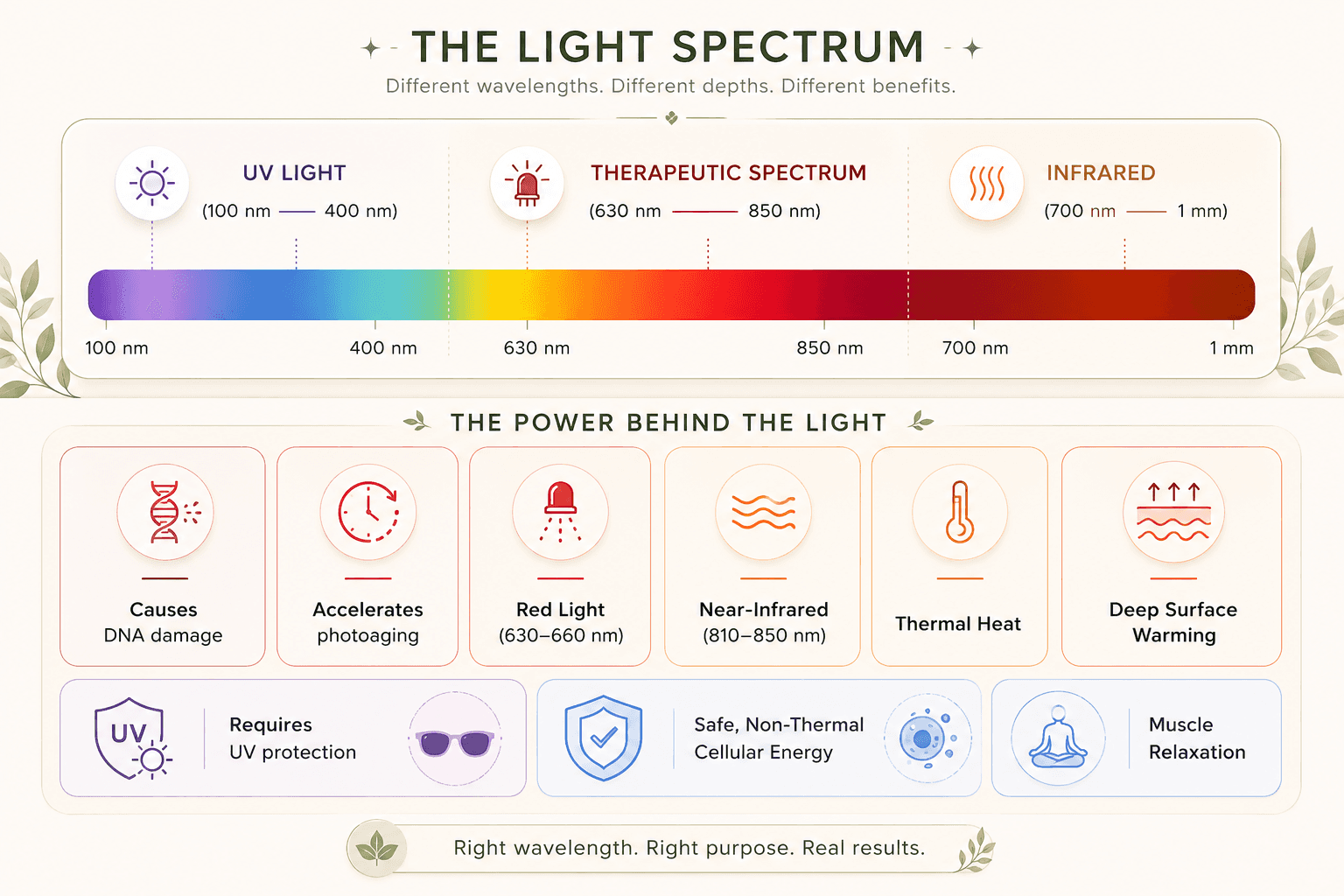
Two specific bands of light do most of the work in photobiomodulation:
Red Light (630 to 660 nm): Well suited to surface-level treatment. Shorter wavelengths like these get absorbed mostly by the epidermis and dermis, so they tend to work best for skin regeneration, collagen production, and calming inflammation near the surface.
Near-Infrared Light (810 to 850 nm): Longer wavelengths that pass through the skin barrier without any visible glow, reaching muscle tissue, tendons, joints, fascia, and even bone. This is the range associated with deeper, more systemic recovery.
Because the light delivers concentrated photons straight to receptors in the tissue without producing much heat, the whole process can support tissue renewal without the side effects that come with thermal treatments.
How It Works: The Cellular Mechanism
Once those photons make it past the skin, understanding what does red light therapy do on a microscopic level comes down to the changes inside the mitochondria (the small structures inside cells responsible for producing energy).
[Light Photons (630–850 nm)]
│
▼
[Cytochrome c Oxidase] ──► Displaces Bound Nitric Oxide
│
▼
[Increased ATP Synthesis] ──► Cellular Energy Surge
│
▼
[Systemic Repair, Collagen Synthesis & Reduced Inflammation]
Reclaiming Mitochondrial Efficiency
Stress, fatigue, and normal ageing all lead to cells producing more reactive oxygen species (ROS) than usual. One consequence of this is that nitric oxide (NO), a molecule that can interfere with cell function, ends up binding to cytochrome c oxidase, an enzyme mitochondria rely on for respiration. Once that binding happens, respiration slows down, energy production drops, and fatigue sets in more easily.
Red and near-infrared light change this. Cytochrome c oxidase absorbs the light energy, and the reaction is enough to release the bound nitric oxide. Oxygen can then move freely through the pathway again, and normal respiration picks back up fairly quickly.
Supercharging ATP Production
With nitric oxide out of the way, mitochondria convert oxygen and nutrients into adenosine triphosphate (ATP) far more efficiently. ATP is what cells use to repair damaged DNA, build proteins like collagen and elastin, remove waste, and manage inflammation. More ATP generally means the cell has more capacity to do all of this.
Cascading Downstream Signals
None of this stays contained to a single cell. As ATP levels rise, nearby tissue responds too: circulation improves, anti-inflammatory signals get released, and stem cells in the area start moving toward spots that need repair.
Key Red Light Therapy Benefits
Because red light therapy works by repairing energy production at the cellular level, the results tend to show up as a smoother skin appearance, physical performance, and general long-term health. These primary red light therapy benefits span:
Target Focus | Primary Biological Action | Visible & Systemic Outcome |
Skin Regeneration | Activates fibroblasts & boosts collagen | Smooths fine lines, tightens lax skin, & unifies texture |
Muscle & Tissue Recovery | Enhances microcirculation & ATP | Reduces delayed onset muscle soreness (DOMS) |
Systemic Longevity | Downregulates pro-inflammatory markers | Alleviates joint stiffness & calms tissue strain |
Circadian Health | Regulates pineal melatonin release | Improves sleep architecture & daytime energy |
Primary Red Light Therapy Uses
Light works as a fairly universal catalyst for tissue repair, which is why red light therapy uses show up across so many areas of health and wellness:
Aesthetic Refinement: Firming and refreshing skin, reducing sun damage, and easing stubborn hyperpigmentation.
Athletic & Physical Recovery: Combining post-workout light exposure with movement to reduce soreness, support connective tissue, and protect joint health.
Scalp & Hair Vitality: Encouraging circulation around dormant hair follicles to support thicker, healthier growth over time.
Wound Healing & Scar Reduction: Speeding up the body's own repair process after procedures or minor injuries.
Stress & Nervous System Balance: Using calm, low-stimulation sessions to help reset the nervous system and ease daily fatigue.
Understanding Red Light Therapy Devices: Professional vs. Home Use
Choosing between consumer and clinical red light therapy devices comes down to a few practical factors: power output, how the light is distributed, and how precisely the wavelength is tuned.
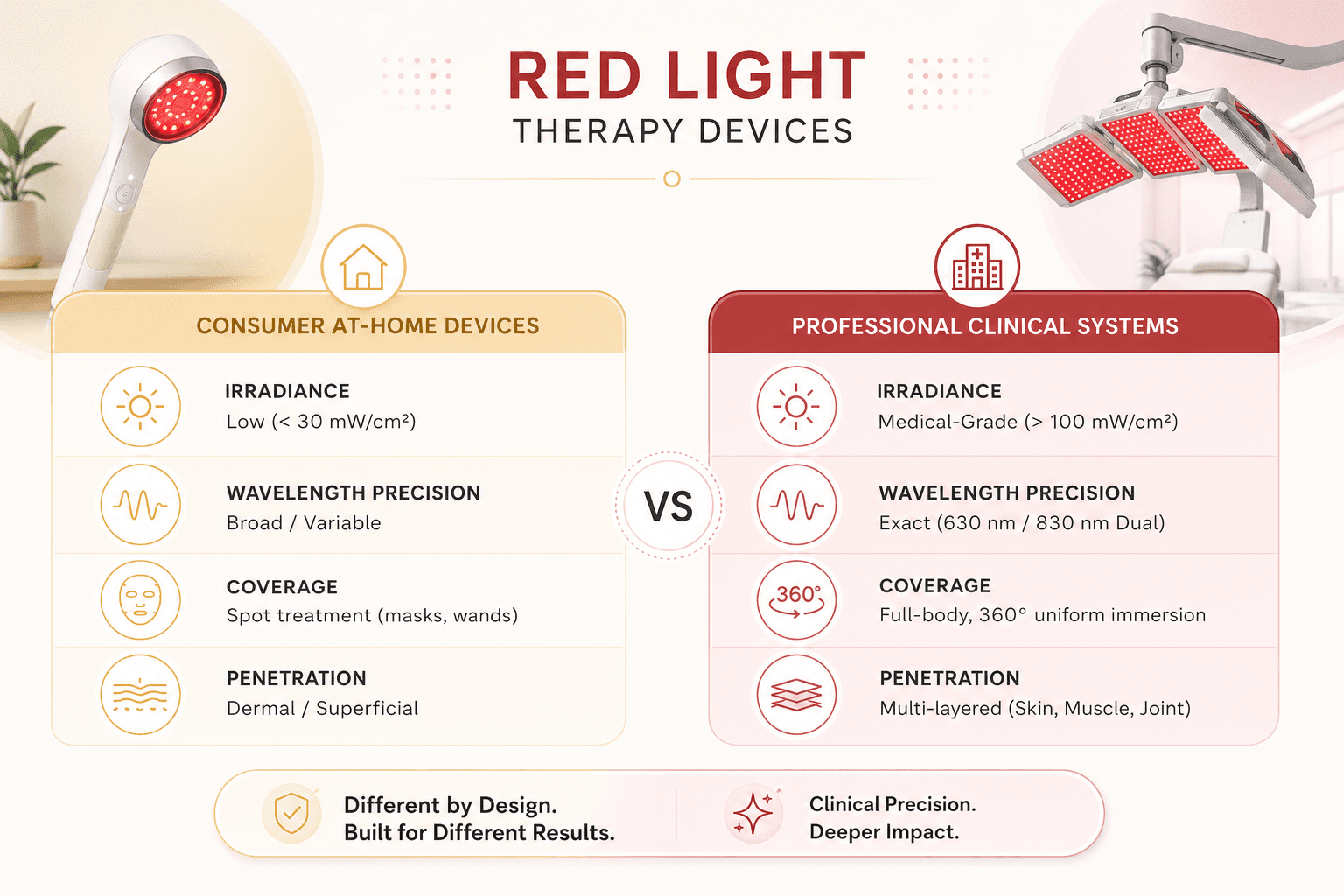
Home red light therapy devices are convenient for regular, light maintenance, but their lower irradiance (essentially the power density reaching the tissue) caps how deep the treatment can go. Reaching muscle beds or joint capsules usually takes clinical-grade equipment, built to deliver a specific dose of energy per square centimetre in a short session.
The ALIINE Philosophy: Integrating Red Light Into an Ecosystem
At Aliine, red light therapy is never treated as a standalone fix. Meaningful, lasting results come from combining technology, movement, and recovery practices so they reinforce one another.
Combined with other modern treatments, red light tends to do more.
Paired with Body Sculpting & EMS: Conditioning muscle tissue with red light beforehand supports deeper engagement during EMS sessions and quicker recovery afterward.
Paired with Infrared Saunas & Longevity Chambers: Switching between deep thermal heat and photobiomodulation improves blood flow, supports detoxification, and encourages broader cellular renewal.
Paired with Skin Regeneration Protocols: Applying red light after dermal treatments can speed recovery, calm redness, and help hold onto collagen gains over time.
Stepping away from scattered, one-off treatments and towards a structured, personalised routine gives the body room to work closer to its full biological potential.
How to Begin Your Red Light Journey
Getting started does not take much preparation, but consistency matters more than almost anything else. Cellular energy builds gradually, so regular sessions tend to produce results that keep improving rather than levelling off early.
Start with clear objectives: Whether the goal is skin health, athletic recovery, or general stress relief, the light spectrum and session length should reflect that.
Expose clean skin: Creams, makeup, and heavy clothing block light from reaching the skin, so a clean surface absorbs it best.
Stay consistent: Short sessions three to five times a week tend to outperform occasional, longer ones.
Treat it as part of a routine: Combine light therapy with regular movement, good hydration, and solid sleep habits so the results hold.
At Aliine, we view red light therapy as a slow and deliberate approach to wellness that works with the body's own biology instead of against it, aiming for visible results, strength, and a steadier sense of balance over time.
Frequently Asked Questions
What are the benefits of red light therapy?
It boosts cellular ATP energy to accelerate repair, stimulate collagen for firmer skin, speed up muscle recovery, reduce inflammation, relieve joint stiffness, and support sleep cycles.
What are the disadvantages of red light therapy?
It requires consistent use over time for results, high-grade devices carry a higher cost, and lower-powered consumer wands often lack the intensity needed to penetrate deeper tissue.
Is 10 minutes of red light therapy enough?
Yes. With clinical-grade equipment, 10 to 15 minutes is ideal to saturate cellular light receptors without diminishing returns.
Can I do red-light therapy at home?
Yes, but home wands and masks offer lower power density (irradiance). They work well for surface maintenance, while full-body clinical arrays are needed for deep muscle and joint recovery.
Can I use red light therapy every day?
Yes. It uses non-damaging, non-UV wavelengths, making daily use safe. Using it 3 to 5 times per week yields optimal cumulative results.

